Behavior with Internal Regulation using Theory-Based Education (BITE) Lab
UCF Department of Health Sciences
Overview
The Behavior with Internal Regulation using Theory-based Education (BITE) Lab conducts research aimed at improving health and nutrition outcomes among children, adolescents and young adults.
The work of the BITE Lab is guided by two distinct core areas. One area focuses on internal self‑regulation in relation to nutrition, including internal processes involved in eating‑related decision‑making. A second area focuses on using theory‑based approaches to guide nutrition education research, including the development and evaluation of such efforts.

All inquiries can be directed to:
Shante.jeune@ucf.edu
What We Do
The BITE Lab focuses on improving community nutrition through theory-based education designed to promote healthier dietary behaviors. Our work incorporates both concise and in-depth assessments of eating behaviors and diet quality, including 24-hour dietary recalls and validated questionnaires.
The BITE Lab also uses wearable technology with ECG sensors to collect continuous, high-quality physiological data (e.g., heart rate) to determine internal regulation behaviors in real-world settings. Small, user-friendly devices allow for the assessment of internal physiological processes related to stress, regulation, and eating-related decision-making without the need for laboratory visits.
1. Internal Regulation
- BIOPAC Research Ring
- Electrocardiogram (ECG)
- Heartbeat discrimination task
- Heartbeat perception task
2. Cognitive Tasks
- Stroop task
- N-back task
- SART task
3. Dietary Assessments
4. Data Acquisition
- BIOPAC MP160 Data Acquisition System
5. Software
- E*Prime Psychology Software Tool
- BIOPAC AcqKnowledge
Meet Our Team

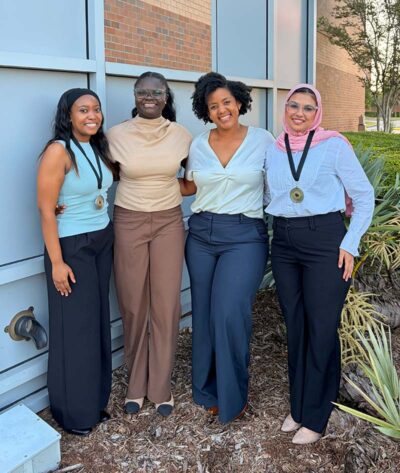
Fatima Alziyad, BS
Graduate Research Assistant/Lab Manager
Esther Nketsiah, BS
Graduate Research Assistant
Jillian Weathington, MS
Graduate Research Assistant/Lab Manager
News

Selected Relevant Publications
Our laboratory makes a concerted effort to publish our findings in respected academic journals and present at regional, national, and international conferences. In addition to contributing to a collective body of knowledge in a given field, presenting original data at conferences is a fun way for the lab students to enhance their self-confidence and network with other scientists.
- The causal associations between interoception, self-regulation, non-purposeful eating behaviors, and weight status in college women: a longitudinal cross-lagged model analysis | Psychology & Health
- Interoception and self-regulation of eating behaviors and weight status in college students | Journal of American College Health
- The Mediating Effect of Eating Behaviors on Interoception, Self-Regulation and Weight Status Among College Students | Nutrients
- Nourishing minds: the connection between healthy eating and academic success in higher education | BMC Public Health
- Exploring Perceived Discrimination and Medical Mistrust among Middle-Aged Black Adults | Journal of Racial & Ethnic Health Disparities
- Changing Dietary Patterns among Chinese Older Adults: A Rural–Urban Comparative Analysis (2008–2018) | International Journal of Behavioral Medicine
- Initial evidence comparing beverage and snack dietary patterns of children with autism spectrum disorders during school versus summer months | International Journal of Developmental Disabilities